NEWS | COMPANY
We are very pleased to have been an official member of the Open Source Business Alliance (OSBA) – the Federal Association for Digital Sovereignty – since November 2025.
With more than 250 member organizations, the OSBA is the largest network of open-source stakeholders in Germany. It brings together software vendors, IT service providers, start-ups, public authorities, research institutions, and committed individuals—united by the shared belief that open-source software plays a key role in a self-determined digital society.
The OSBA connects these voices, strengthens their impact in political discussions, and creates space for exchange—on a technical, strategic, and very practical level. This combination of a clear stance, open dialogue, and hands-on work convinced us: this is where we want to contribute.
Why Open Source Is More Than a Licensing Model for Us
This membership is a logical step for us: OTOBO is not an open service management platform by chance. Open standards, transparency, and genuine collaboration are the foundation and starting point of our work.
We forked OTOBO because opportunities for the community to actively contribute to the predecessor project were increasingly restricted—out of conviction and well before its end of life. Our goal was clear: to build a fully open-source service management solution with a strong and active community.
For us, open source means more than making code publicly available. It means thinking about development collaboratively and sharing responsibility—both in customer projects and in our partnerships. In everyday practice, this means implementing features in a way that fits the standard whenever possible, so everyone can benefit. It means sharing effort across many shoulders and developing things once instead of multiple times in parallel.
Then as now, this principle applies: OTOBO is and remains 100% open source and free of license costs. There is no business edition, no paid add-ons, and no hidden limitations.
Of course, a different business model might generate higher profits. But for us, it is equally important to act responsibly, sustainably, and with the common good in mind.
What This Has to Do with Digital Sovereignty
Digital sovereignty is a term that is used frequently—and often remains abstract. For us, it is very concrete.
Digital sovereignty means retaining control over your own systems and data. Knowing what your software does. Deciding where it runs. And avoiding dependencies that are difficult—or impossible—to escape.
Especially today, this is not a theoretical ideal but a practical necessity. For public administrations and critical infrastructures, but also for companies and individuals. Those who do not understand their technical dependencies today will pay the price tomorrow—financially, organizationally, or politically.
Open source is not a cure-all, but it is a crucial prerequisite. Open-source software creates transparency. It enables choice. It allows adaptation and gives users the freedom to make informed, self-determined decisions.
For us as a software provider, digital sovereignty also means taking responsibility: for maintainable software, for long-term development, and for an ecosystem focused not on short-term gains but on sustainability.
That is why, in further development, we make sure to implement individual requirements in ways that strengthen the overall standard—instead of creating custom solutions that lead to long-term dependencies. The result is software that uses resources efficiently and genuinely supports independence.
Why the OSBA Is the Right Network for Us
We are convinced that openness, collaboration, and shared knowledge form the foundation of a future-ready digital society.
At a time when open technology and independence are gaining increasing importance due to current political developments, we believe the moment has come to not only live this mindset within our own product, but to actively contribute on a broader level as well.
At the OSBA, organizations and individuals come together who see open source not as a niche topic, but as the foundation of the digital future. For digital sovereignty to be more than a buzzword, open source needs a shared voice. Individual companies can make a difference—but structural change happens when many join forces.
That is why we joined the OSBA. We want to be part of a network that actively shapes and advances digital sovereignty and sustainable IT structures.
A First Concrete Step – OSBA Connect
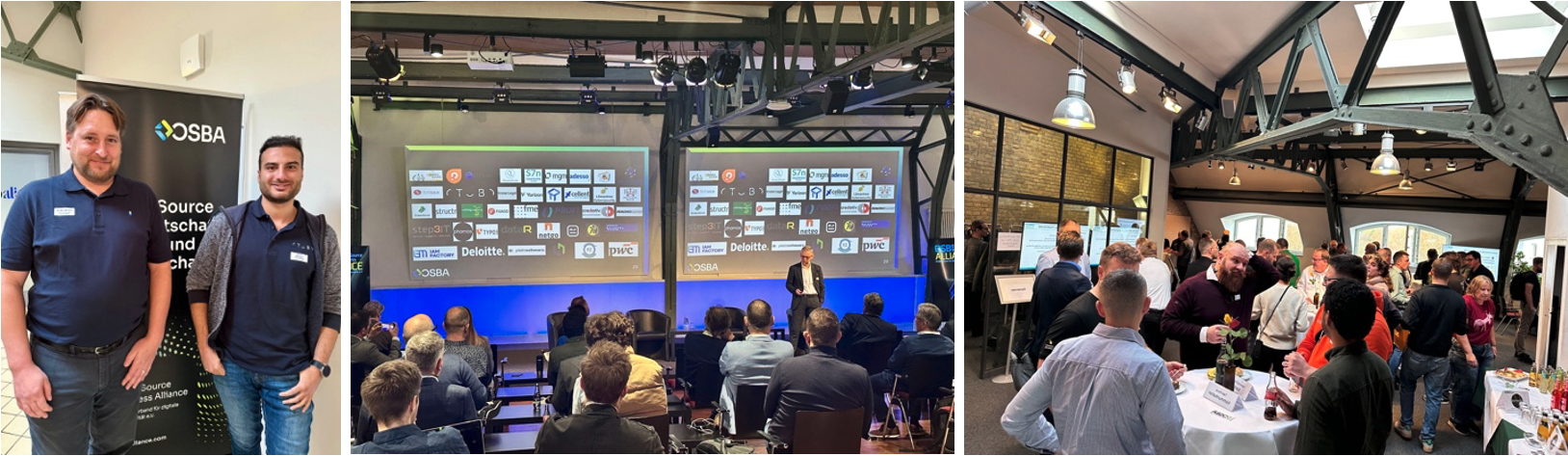
In November, we were already in Berlin for our first general assembly as a member: OSBA Connect 2025.
It quickly became clear how committed and diverse the open-source community is—and how much energy and shared vision this network brings together. In discussions, panels, and working groups, the focus was on very concrete questions, such as:
-
How can open source act as an innovation driver for modernizing the public sector?
-
What is needed to ensure open source is better considered in public procurement?
-
Which framework conditions are required to operate open solutions sustainably?
-
How can collaboration succeed across organizational and national boundaries?
Practical insights illustrated both opportunities and challenges—and showed what is truly possible.
Equally valuable to us was the personal exchange. The conversations, impulses, and open atmosphere confirmed one thing clearly: this is not just about technical solutions, but about shared responsibility and the question of how we can shape our digital future independently.
We are very much looking forward to getting actively involved and contributing our part.
